
The 12 Best AI Marketing Automation Tools for Growth in 2026
- Emmanuel Adesokan
- Feb 13
- 19 min read
Updated: Mar 6
Navigating the crowded market of AI marketing automation tools can be a significant challenge for any marketing leader. The right platform can revolutionise your demand generation, streamline customer journeys, and provide the data-driven insights needed for scalable growth. The wrong choice, however, can lead to wasted budget, team frustration, and a technology stack that hinders rather than helps your go-to-market strategy. Before diving into specific platforms, it's crucial to understand the foundational concepts. For a clear overview, see this article explaining What Is Marketing Automation?.
This guide is designed to cut through the noise. We provide a comprehensive, actionable roundup of the top platforms, organised by primary use case to help you quickly identify the best fit for your business needs, whether you're a SaaS startup, a B2B enterprise, or a growing e-commerce brand. We move beyond generic feature lists to offer a practical analysis of each tool's strengths and weaknesses.
Inside, you will find:
Detailed breakdowns of leading platforms like HubSpot, Salesforce, Marketo Engage, and Klaviyo.
Direct comparisons of features, pricing signals, and integration capabilities.
Honest pros and cons based on real-world application and user feedback.
Practical implementation guidance to help you get started quickly and effectively.
Screenshots and direct links for every tool, allowing for easy evaluation.
Our goal is to equip you with the information necessary to make a confident, strategic decision. This resource will help you select the AI marketing automation tool that aligns with your specific objectives, from campaign automation and hyper-personalisation to CRM integration and advertising optimisation. Let's explore the solutions that can transform your marketing efforts.
1. HubSpot Marketing Hub
HubSpot Marketing Hub stands as a comprehensive, all-in-one platform, making it a cornerstone for teams seeking unified ai marketing automation tools. It expertly merges a powerful CRM with marketing, sales, and service functions, creating a single source of truth for customer data. This integration is its key differentiator, allowing for deeply personalised and automated campaigns based on a complete view of the customer journey.
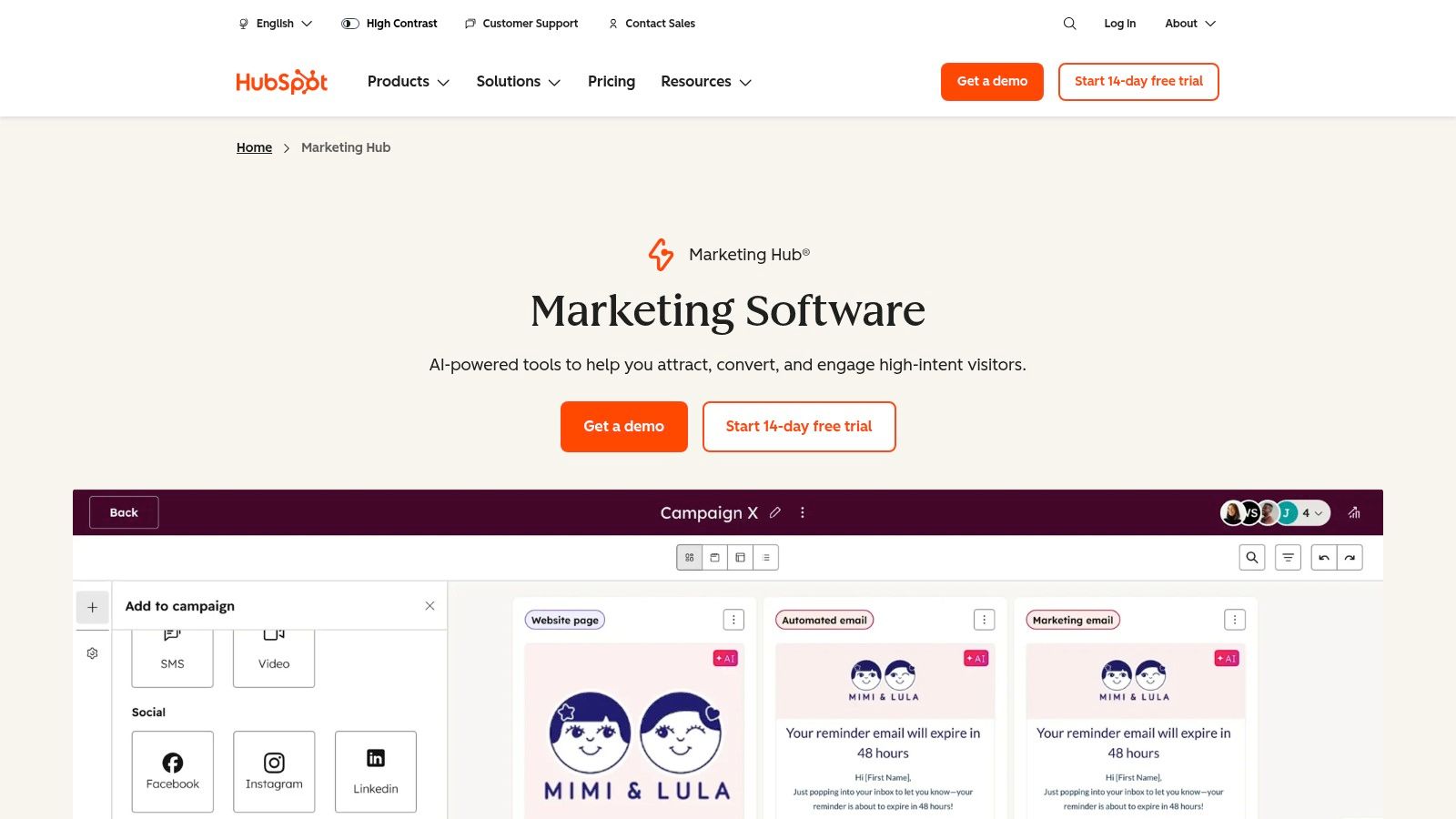
Its native AI features, branded as HubSpot AI, are embedded across the platform. Users can generate blog posts, social media copy, and email subject lines, or even build entire campaigns with AI assistance. The platform excels at creating complex automation workflows that trigger actions based on user behaviour, from lead scoring to nurturing sequences, directly tying marketing efforts to revenue attribution. For startups, understanding how to leverage these sophisticated tools can be a significant advantage, and exploring how AI consulting can transform a startup’s future provides a strategic framework for implementation.
HubSpot Key Features & Considerations
AI-Augmented Content: Built-in assistants for creating emails, ad copy, and landing pages.
Deep CRM Integration: Automations are fuelled by rich, unified customer data, enabling hyper-personalisation.
Scalability: The platform grows with your business, from a free-tier CRM to enterprise-level features without needing to re-platform.
Pricing Complexity: Costs scale based on contact tiers, user seats, and optional add-ons, requiring careful budget planning. Mandatory onboarding for Professional and Enterprise tiers adds an initial investment.
Feature | Availability & Notes |
|---|---|
Ideal For | SaaS, B2B, and e-commerce teams needing a single customer view. |
Core Strength | Unifying marketing, sales, and service data for automation. |
Pricing Model | Tiered (Free, Starter, Professional, Enterprise); contact-based. |
User Experience | Highly intuitive and well-regarded for its clean interface. |
2. Salesforce Marketing Cloud Account Engagement (formerly Pardot)
Salesforce Marketing Cloud Account Engagement is an enterprise-grade platform designed for B2B marketers who need deep alignment with their sales counterparts. As one of the more powerful ai marketing automation tools, its core strength lies in its native integration with the Salesforce CRM, creating a seamless data flow between marketing engagement and sales activities. This tight coupling allows for sophisticated automation based on both marketing interactions and sales pipeline stages, making it ideal for complex account-based marketing (ABM) strategies.
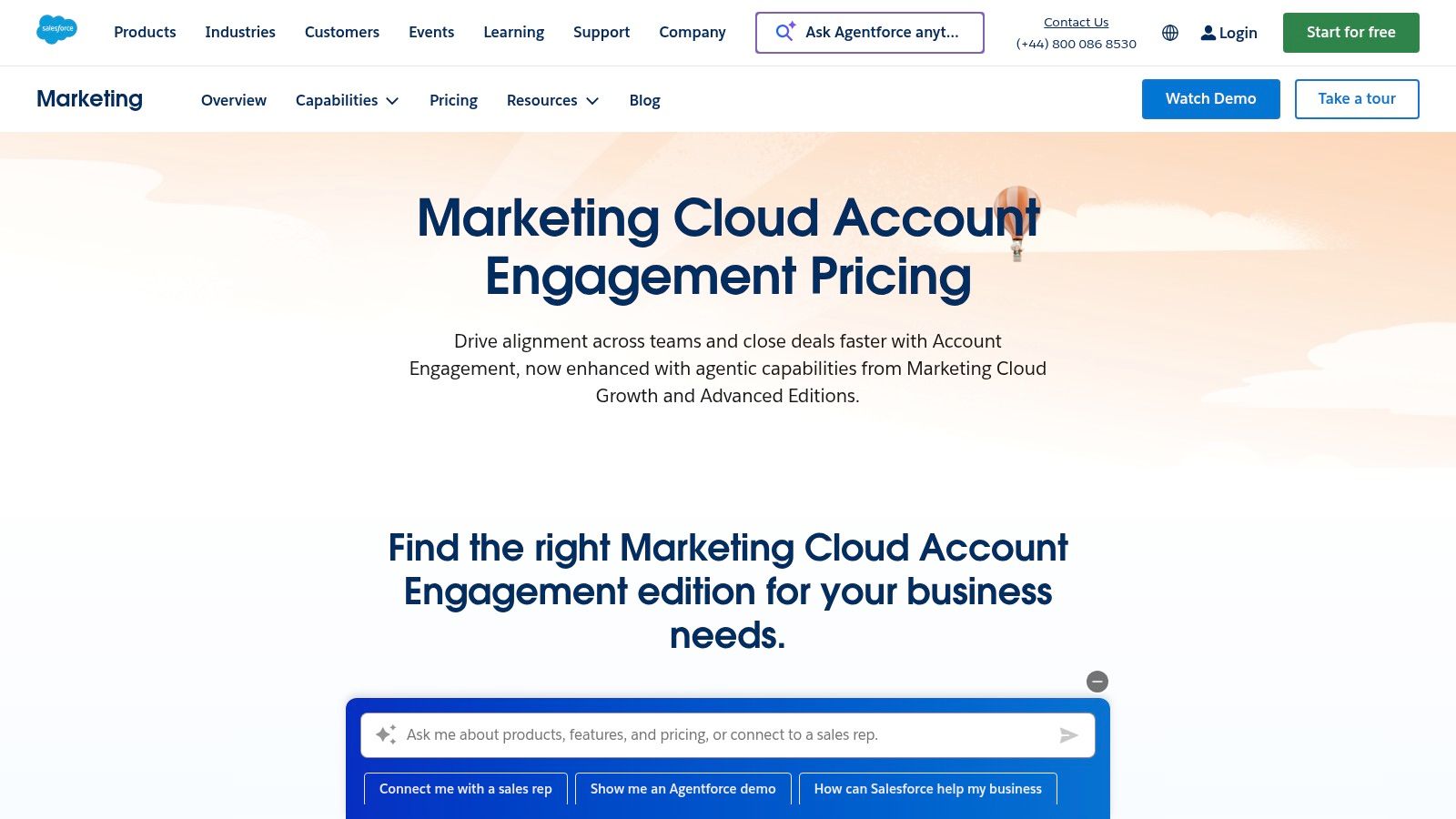
The platform leverages AI primarily through Marketing Cloud Next, offering features for AI-assisted campaign creation, dynamic content personalisation, and predictive lead scoring. It excels at automating the entire lead lifecycle, from initial capture to nurturing and sales handover. The robust ROI reporting provides clear insights into campaign performance, demonstrating marketing's direct impact on revenue. Understanding the role of analytics in shaping marketing decisions is crucial for maximising the value of these reports and refining strategies for better outcomes.
Salesforce Key Features & Considerations
Native CRM Sync: Unparalleled, bidirectional data synchronisation with Salesforce Sales Cloud for a unified revenue team.
Advanced Lead Management: Sophisticated lead scoring, grading, and routing capabilities to ensure high-quality leads reach sales.
Enterprise Governance: Features like business units and sandboxes cater to large, complex organisations with multiple teams.
High TCO: The total cost of ownership can be significant, with annual contracts and add-ons for advanced features. It delivers the best value for companies already invested in the Salesforce ecosystem.
Feature | Availability & Notes |
|---|---|
Ideal For | Enterprise B2B companies with established Salesforce CRM usage. |
Core Strength | Aligning marketing and sales teams with shared data and processes. |
Pricing Model | Tiered (Growth, Plus, Advanced, Premium); requires annual contract. |
User Experience | Powerful and highly customisable, but can have a steep learning curve. |
3. Adobe Marketo Engage
Adobe Marketo Engage is an enterprise-grade platform tailored for complex, large-scale B2B and B2C marketing operations. It excels at managing intricate customer journeys, especially for businesses that operate across multiple brands or regions. As one of the more mature ai marketing automation tools, its core strength lies in its powerful lead management, multi-touch revenue attribution, and deep personalisation capabilities, making it a cornerstone for revenue-focused marketing teams.
The platform leverages AI to power predictive audiences, personalise content at scale, and optimise lead and account-based experiences. It offers robust native integrations, particularly with Salesforce and Microsoft Dynamics, and a mature API for building custom tech stacks. This makes it a powerful choice for organisations needing to orchestrate sophisticated campaigns where tying marketing activities directly to complex sales cycles and revenue outcomes is critical.
Adobe Key Features & Considerations
Advanced Attribution: Provides multi-touch attribution and revenue-cycle modelling to demonstrate marketing's ROI.
Enterprise Orchestration: Designed to manage complex marketing workflows across multiple brands, regions, and business units.
Strong Extensibility: A robust API and a strong partner ecosystem allow for deep customisation and integration.
High Total Cost & Complexity: Pricing is quote-based and typically represents a significant investment. Implementation and ongoing management often require specialist support or a dedicated internal team to realise its full potential.
Feature | Availability & Notes |
|---|---|
Ideal For | Enterprise B2B companies with complex sales cycles and global teams. |
Core Strength | Revenue attribution and orchestrating complex, multi-channel journeys. |
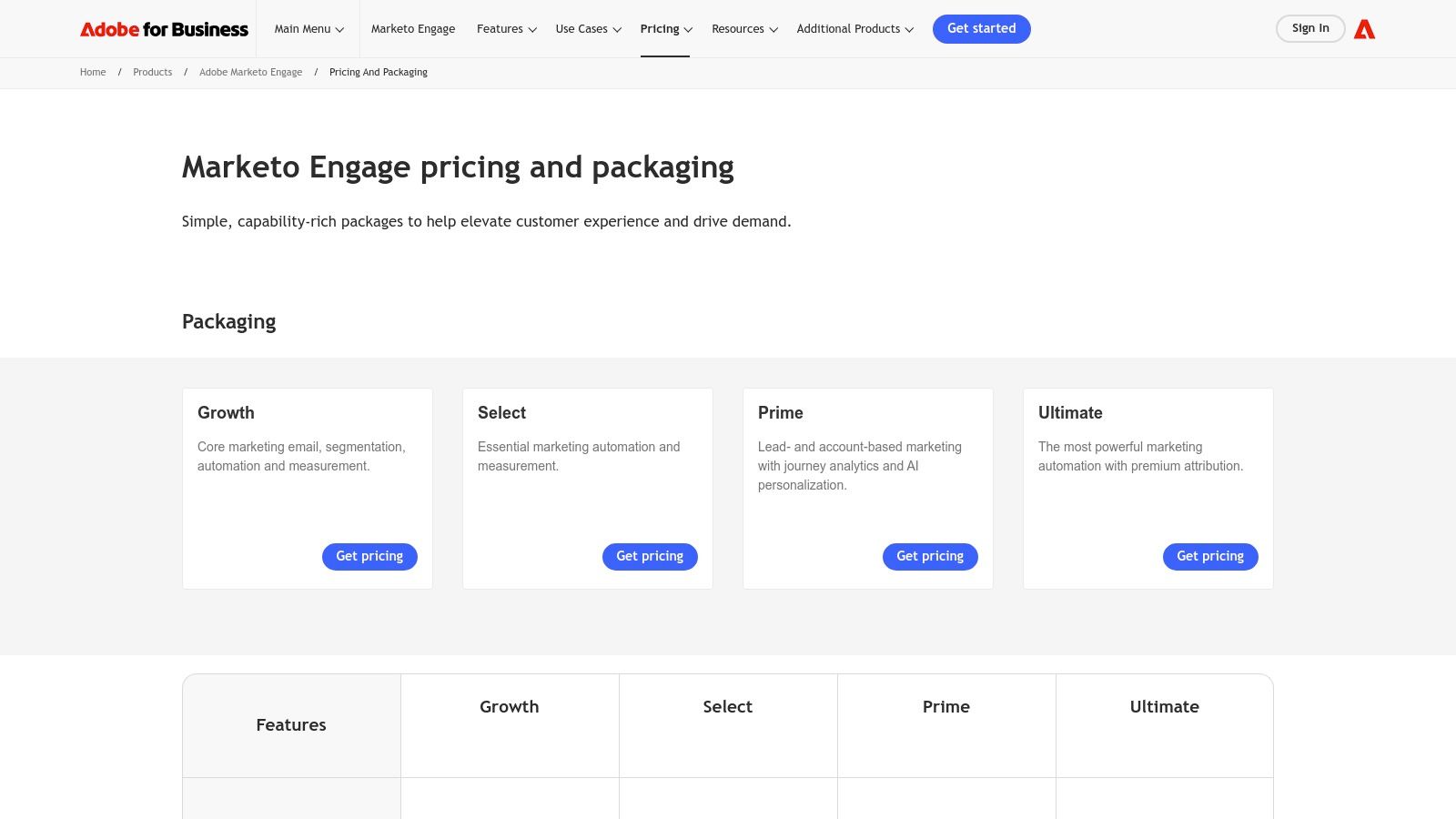
Pricing Model | Quote-based tiered editions (Growth, Select, Prime, Ultimate). |
User Experience | Powerful and feature-rich, but has a steeper learning curve. |
4. Mailchimp (Intuit Mailchimp)
Mailchimp has evolved from a simple email service into a more rounded marketing platform, making it an accessible entry point for small businesses and startups exploring ai marketing automation tools. It excels at providing a low-friction start, allowing users to quickly set up email campaigns, landing pages, and automated customer journeys. Its user-friendly interface and extensive template library remove much of the initial complexity often associated with marketing automation.
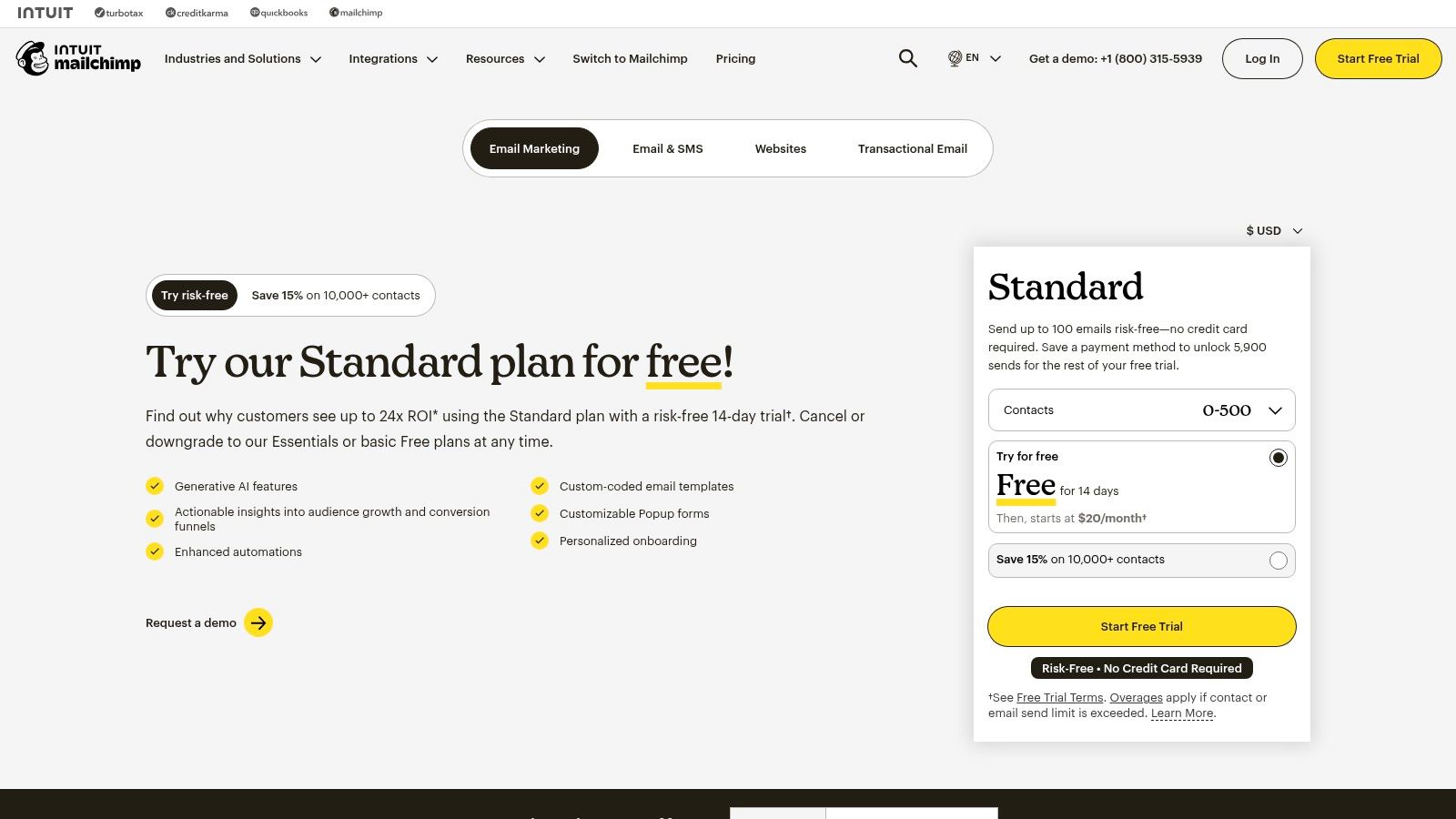
The platform has progressively integrated AI features, such as the Creative Assistant for generating design assets and AI-powered suggestions for subject lines and send times to optimise engagement. Its journey builder provides a visual way to create multi-step automations based on audience behaviour, like welcome sequences or abandoned cart reminders. For founders just beginning their journey, understanding the fundamentals is key, and this guide to email automation campaigns offers a solid foundation for leveraging such tools effectively.
Mailchimp Key Features & Considerations
AI Creative Assistant: Generates custom designs and copy suggestions to streamline campaign creation.
Accessible Automation: The visual journey builder simplifies the process of creating trigger-based email sequences.
Vast Integration Marketplace: Connects seamlessly with hundreds of apps, including major e-commerce platforms like Shopify and WooCommerce.
Cost Scaling: While the free and entry-level tiers are attractive, costs can escalate quickly as your contact list grows or if you exceed sending limits, requiring careful management. Advanced segmentation and testing features are reserved for higher-priced plans.
Feature | Availability & Notes |
|---|---|
Ideal For | E-commerce, small businesses, and startups needing a fast start. |
Core Strength | Simplicity, ease of use, and a vast library of integrations. |
Pricing Model | Tiered (Free, Essentials, Standard, Premium); contact/send-based. |
User Experience | Highly intuitive and praised for its straightforward interface. |
Website: https://mailchimp.com/pricing/
5. Klaviyo
Klaviyo has solidified its position as the go-to platform for e-commerce brands seeking sophisticated ai marketing automation tools for email and SMS. It excels by connecting directly to commerce platforms like Shopify and WooCommerce, pulling in real-time behavioural and transactional data. This deep integration allows for hyper-targeted segmentation and automation based on customer actions, such as purchase history, browsing behaviour, and predicted churn risk.
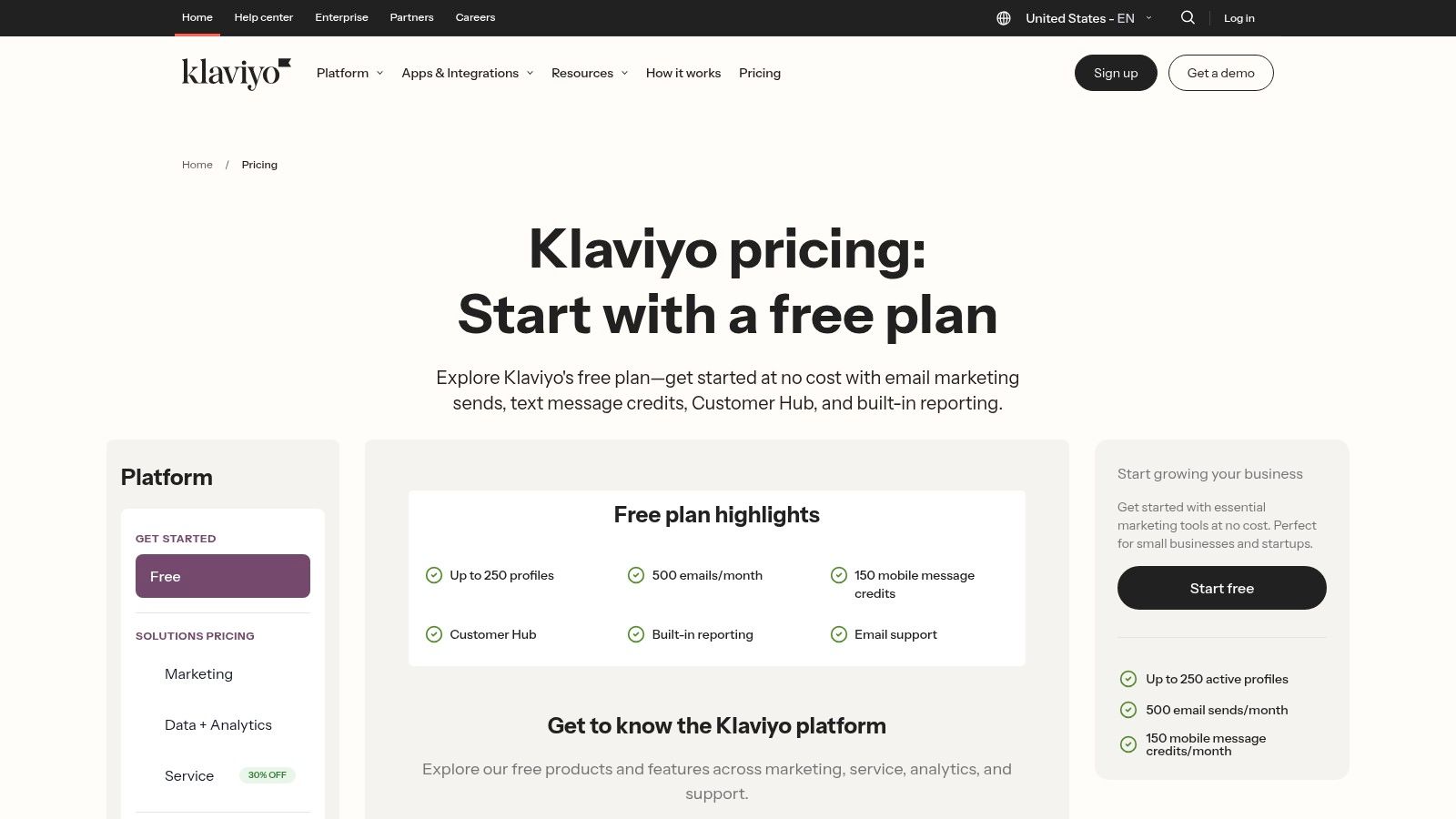
The platform’s AI features are built with direct revenue impact in mind. Users can leverage AI to generate high-converting subject lines and entire campaign copy, informed by data from top-performing brands in their industry. Its predictive analytics are a standout feature, forecasting key metrics like a customer's next order date, lifetime value, and churn probability. This allows marketers to create proactive campaigns, such as special offers for at-risk customers or timely reminders for repeat purchases, directly linking automation to sales growth.
Klaviyo Key Features & Considerations
Predictive Analytics: AI-driven insights on customer lifetime value (CLV), churn risk, and potential gender.
Deep Commerce Integrations: Real-time data sync with Shopify, Magento, WooCommerce, and BigCommerce for behavioural triggers.
AI-Powered Content: Assistants for generating effective subject lines and SMS/email copy tailored for commerce.
Transparent Pricing: A clear, profile-based pricing model that scales predictably, but costs can rise significantly for large lists. The focus is primarily on e-commerce, making it less ideal for B2B or SaaS.
Feature | Availability & Notes |
|---|---|
Ideal For | E-commerce and direct-to-consumer (D2C) brands of all sizes. |
Core Strength | Unifying commerce data for predictive, revenue-driven automation. |
Pricing Model | Tiered (Free, Email, Email & SMS); based on active profile counts. |
User Experience | User-friendly interface with powerful segmentation and flow builders. |
Website: https://www.klaviyo.com/pricing
6. ActiveCampaign
ActiveCampaign positions itself as a customer experience automation platform, blending its powerful email marketing and automation roots with a robust, AI-enhanced CRM. It stands out by offering sophisticated automation capabilities, often found in enterprise-level ai marketing automation tools, at a price point accessible to small and medium-sized businesses. The platform is designed around a visual automation builder that allows users to create intricate, goal-aware workflows triggered by a vast range of customer behaviours and data points.
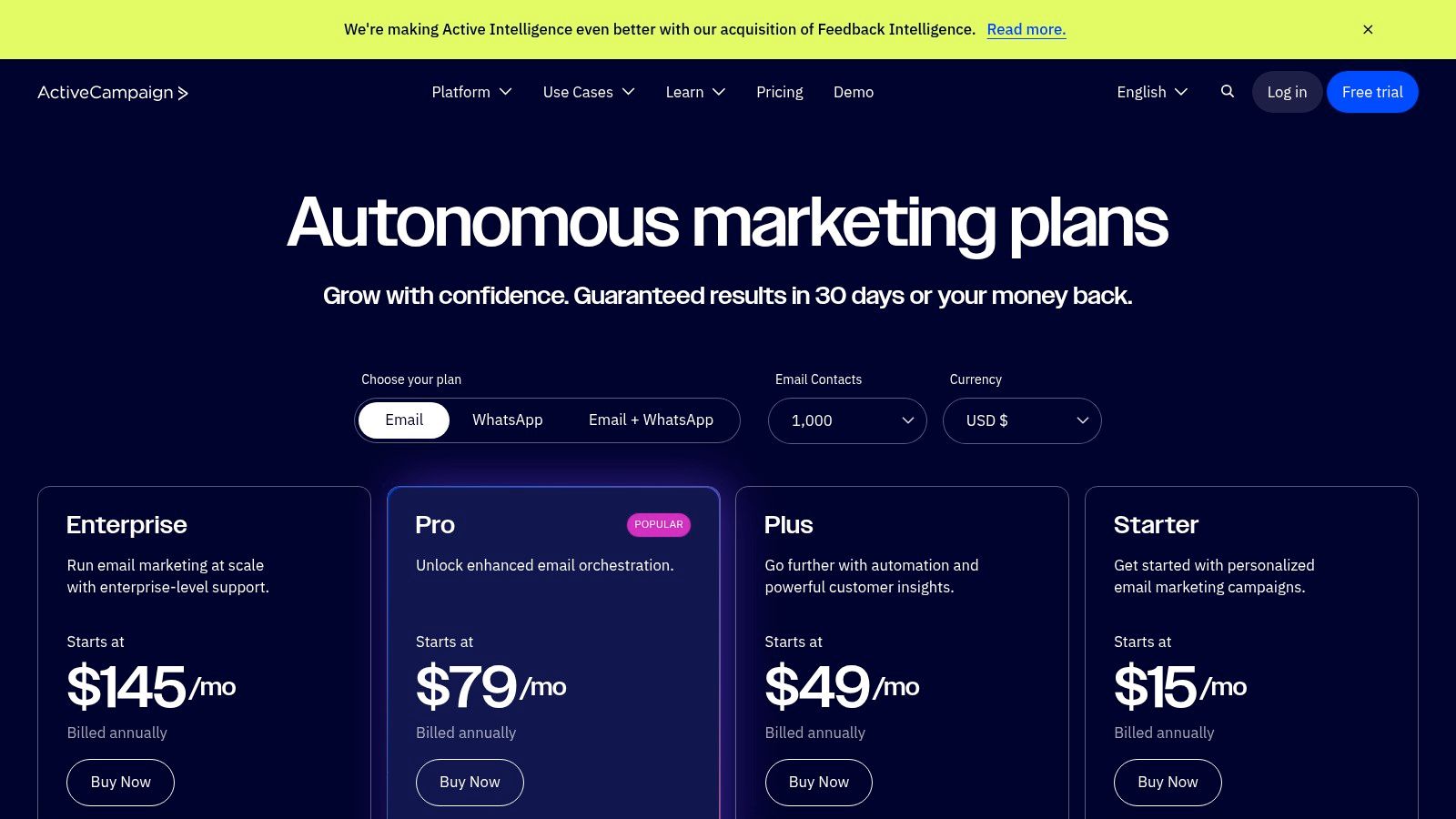
Its native AI, branded as ‘Active Intelligence,’ focuses on practical applications like predictive sending to optimise email open rates, predictive content to personalise messaging, and win probability scoring within its CRM. This makes it a strong contender for SaaS and e-commerce businesses that need to automate communication across multiple channels, including email, SMS, and website messages, without the complexity or cost of an all-in-one suite. The extensive integration library ensures it can act as the central automation hub for a diverse marketing stack.
ActiveCampaign Key Features & Considerations
Advanced Automation Builder: A highly flexible, visual workflow editor for creating complex, multi-path customer journeys.
Multi-Channel Communication: Natively supports email, SMS, landing pages, and website messaging for unified campaigns.
Integrated Sales CRM: Provides lead scoring, deal tracking, and win probability AI to align marketing and sales efforts.
Tiered Feature Access: The most powerful AI features, such as predictive sending and advanced reporting, are reserved for higher-priced plans, which can be a barrier for smaller businesses.
Feature | Availability & Notes |
|---|---|
Ideal For | SMBs, SaaS, and e-commerce businesses needing powerful automation. |
Core Strength | Sophisticated visual automation workflows and multi-channel support. |
Pricing Model | Tiered (Plus, Professional, Enterprise); contact-based scaling. |
User Experience | The automation builder is powerful but can have a steeper learning curve. |
7. Braze
Braze is an enterprise-grade customer engagement platform designed for real-time, cross-channel orchestration. It stands out among ai marketing automation tools for its focus on mobile-first and product-led businesses that require immense scale and speed. The platform's core strength lies in its sophisticated data architecture, enabling brands to act on customer signals instantly across mobile, web, and email, creating highly contextual and personalised experiences.
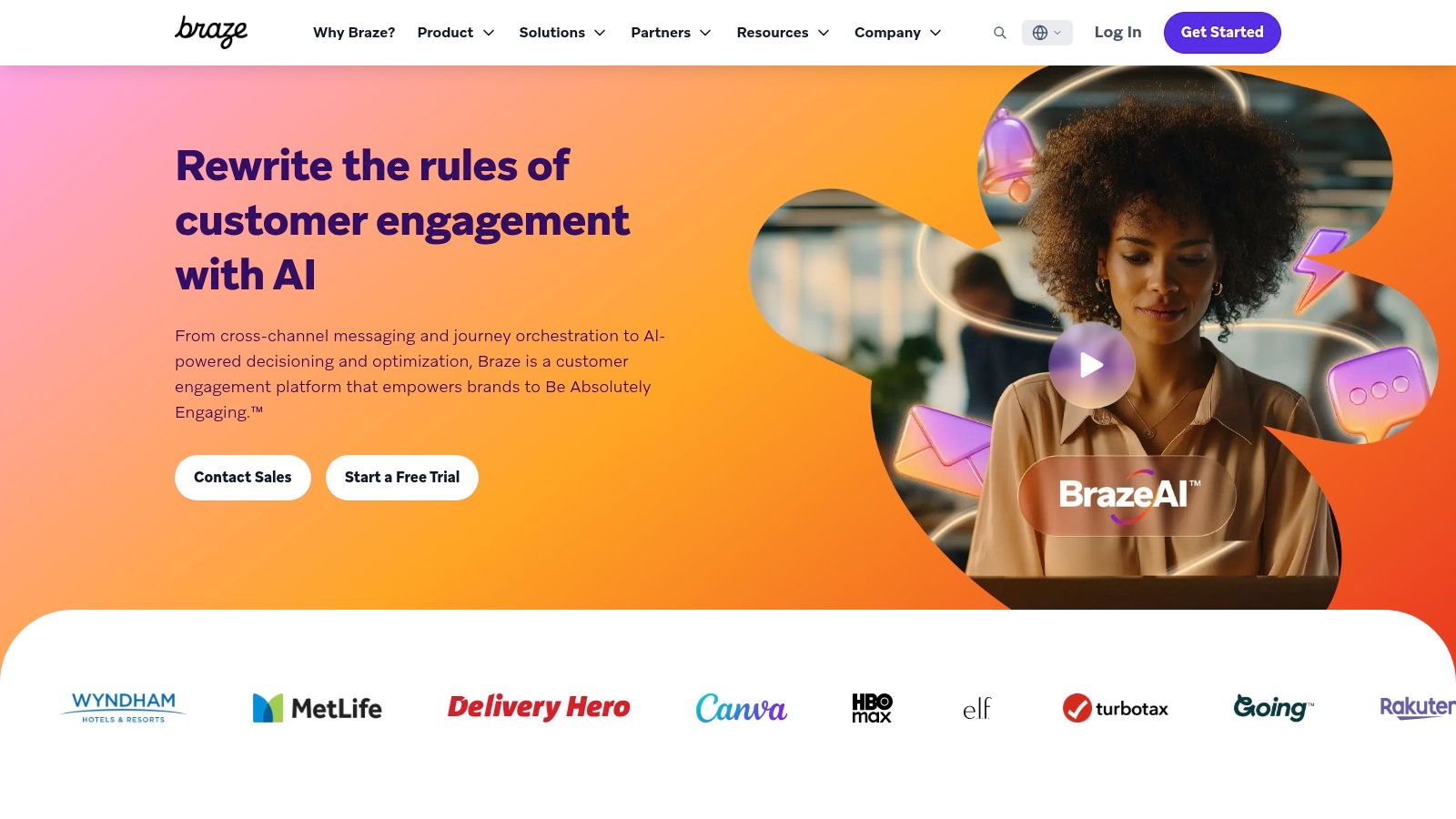
Its native AI suite, Braze AI, powers intelligent decision-making throughout the customer journey. Features range from predictive churn modelling and purchase likelihood to automated send-time and channel selection for each individual user. The Canvas Flow journey builder is a powerful visual tool for mapping complex, multi-step campaigns that adapt in real-time based on user behaviour. For teams with advanced data capabilities, Braze supports warehouse-native triggers and even bring-your-own large language model (BYO-LLM) options, offering unparalleled flexibility.
Braze Key Features & Considerations
Intelligent Orchestration: AI-powered decisioning determines the best content, timing, and channel for individual users.
High-Scale Performance: Architected for real-time data ingestion and messaging delivery to millions of users.
Advanced Data Flexibility: Offers modern data architecture with options for warehouse-native triggers and custom AI models.
Enterprise Focus: Pricing is quote-based and requires a significant implementation effort, making it unsuitable for small businesses or simple email-only strategies.
Feature | Availability & Notes |
|---|---|
Ideal For | Enterprise PLG, mobile-first, and large e-commerce businesses. |
Core Strength | Real-time, AI-driven personalisation and cross-channel journeys. |
Pricing Model | Quote-based; enterprise-level investment is expected. |
User Experience | Powerful and flexible, but comes with a steeper learning curve. |
Website: https://www.braze.com/
8. Customer.io
Customer.io excels as an event-driven automation platform, making it a top choice for technical marketers and SaaS companies focused on product-led growth. It's designed to trigger messages based on what users do (or don't do) within an application, rather than just demographic data. This makes it one of the more sophisticated ai marketing automation tools for creating highly contextual, real-time communication flows across multiple channels.
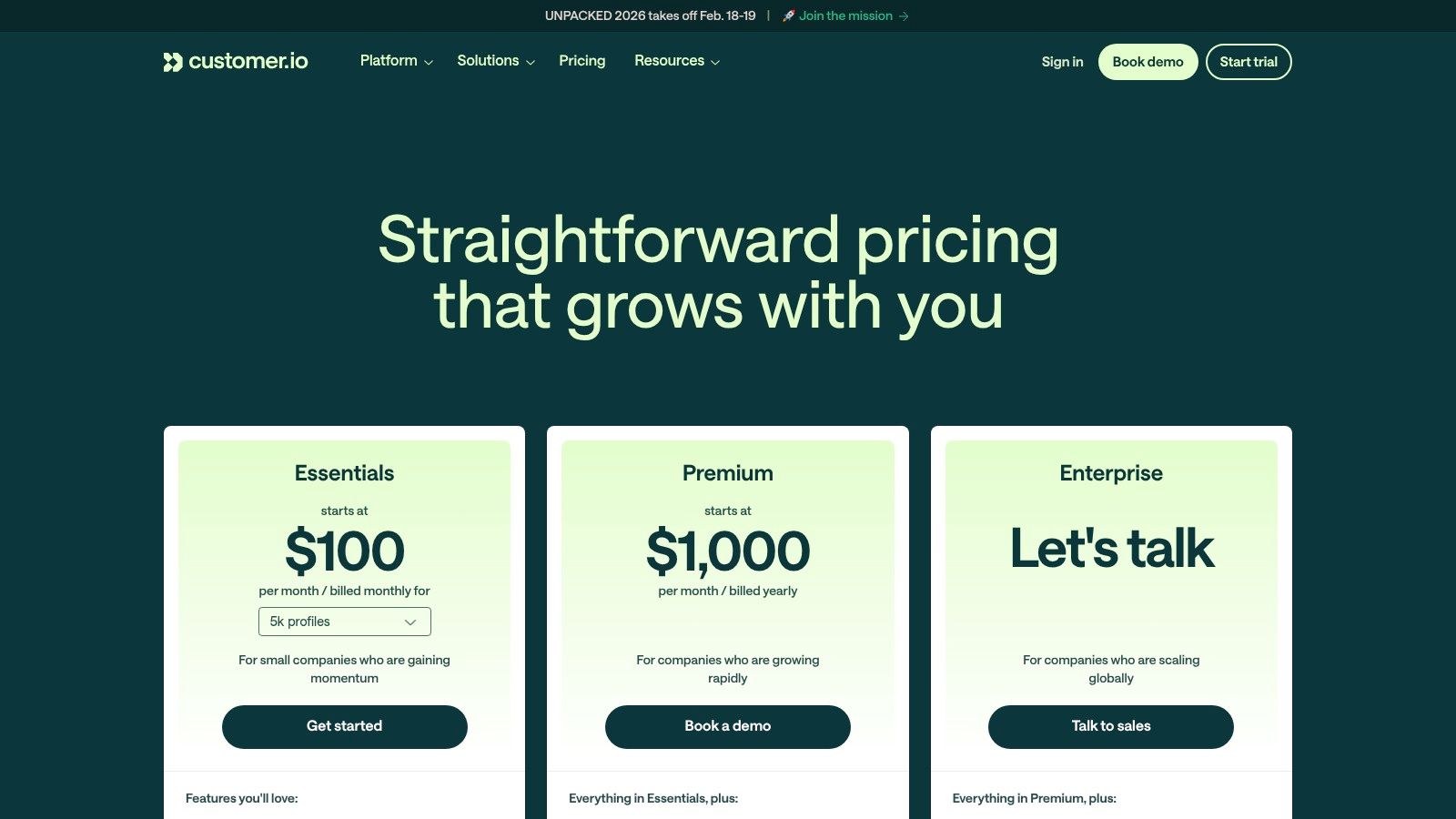
The platform's strength lies in its flexible data model, which accommodates not just people but also objects, allowing marketers to build campaigns around things like subscriptions, projects, or company accounts. Its visual workflow builder is powerful, enabling complex branching logic triggered by API calls, making it ideal for automating onboarding sequences, feature announcements, and re-engagement campaigns based on granular in-app behaviour. This developer-friendly approach ensures that marketing automation is deeply integrated with the product itself.
Customer.io Key Features & Considerations
Event-Driven Workflows: Automations are triggered by real-time user actions and events from your app or website.
Multi-Channel Messaging: Natively supports email, push notifications, SMS, in-app messages, and webhooks for broad reach.
Flexible Data Model: Manages complex relationships between users and objects (e.g., workspaces, companies) for advanced segmentation.
Tiered Feature Access: More advanced capabilities, such as premium integrations or HIPAA compliance, are reserved for higher-priced plans, requiring an upgrade as needs evolve.
Feature | Availability & Notes |
|---|---|
Ideal For | Product-led SaaS, mobile apps, and tech companies with developer resources. |
Core Strength | Triggering complex, multi-channel campaigns from real-time product events. |
Pricing Model | Tiered (Essentials, Premium); based on user profiles and message volumes. |
User Experience | Powerful and flexible, but may have a steeper learning curve for non-technical users. |
Website: https://customer.io/pricing/
9. Brevo (formerly Sendinblue)
Brevo positions itself as an affordable all-in-one platform, making it one of the most accessible ai marketing automation tools for small to medium-sized businesses. Its key differentiator is a pricing model based primarily on email send volume rather than the number of contacts stored, which provides predictable costs for businesses focused on growing their audience without immediate budget increases. This approach makes it highly appealing for SMBs, particularly in the UK, who need to manage costs carefully as their contact lists expand.
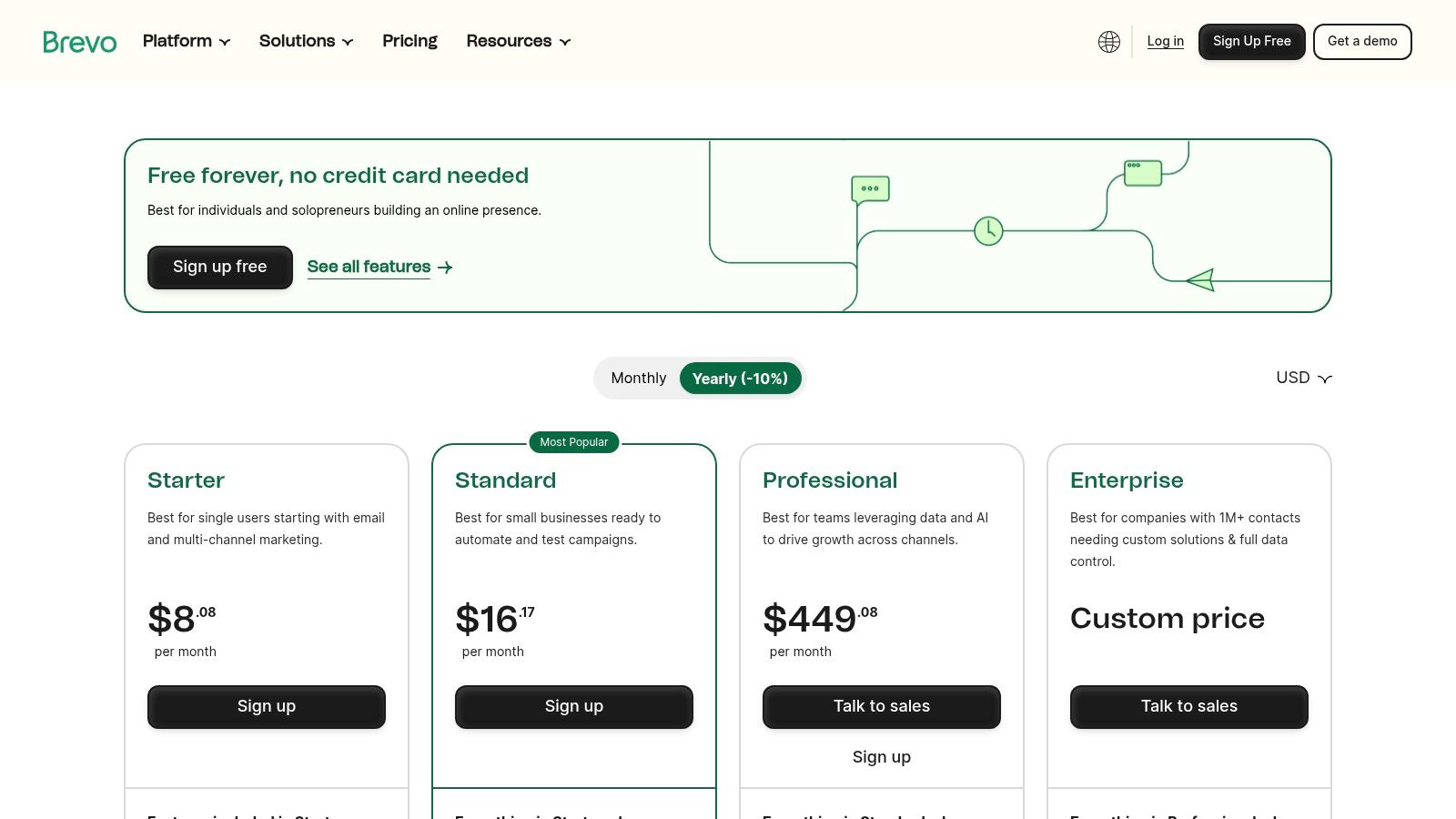
The platform integrates a broad suite of communication channels, including email, SMS, WhatsApp, and web push notifications, into a single automation builder. Its AI features focus on practical optimisations, such as determining the best time to send an email for maximum engagement and assisting with content generation. For businesses needing multi-channel campaign capabilities without the enterprise-level price tag, Brevo offers a compelling and comprehensive starting point, allowing them to test and automate across various touchpoints from one central hub.
Brevo Key Features & Considerations
Predictable Pricing: The 'pay for sends' model is a significant advantage for companies with large but low-engagement contact lists.
Multi-Channel Reach: Natively supports email, SMS, WhatsApp, and web push, enabling cohesive, automated campaigns across channels.
Generous Free Tier: Offers a robust free plan that allows extensive testing of core features before committing to a paid subscription.
Tiered Feature Access: More advanced analytics, A/B testing, and enterprise-grade features are reserved for higher-tier plans or require add-ons, which can increase costs.
Feature | Availability & Notes |
|---|---|
Ideal For | SMBs, e-commerce, and startups needing an affordable all-in-one solution. |
Core Strength | A cost-effective, multi-channel marketing suite with send-based pricing. |
Pricing Model | Tiered (Free, Starter, Business, BrevoPlus); primarily send-based. |
User Experience | Straightforward and user-friendly, designed for easy adoption. |
Website: https://www.brevo.com/pricing/
10. Ortto (formerly Autopilot)
Ortto, formerly known as Autopilot, has evolved from a visual journey builder into a unified customer data platform (CDP) combined with messaging and analytics. Its strength lies in making complex lifecycle marketing accessible, allowing teams to visually map and automate customer journeys across email, SMS, and in-app messages. This visual-first approach is a key differentiator, making it one of the more intuitive ai marketing automation tools for marketers who want to connect actions to outcomes without deep technical expertise.
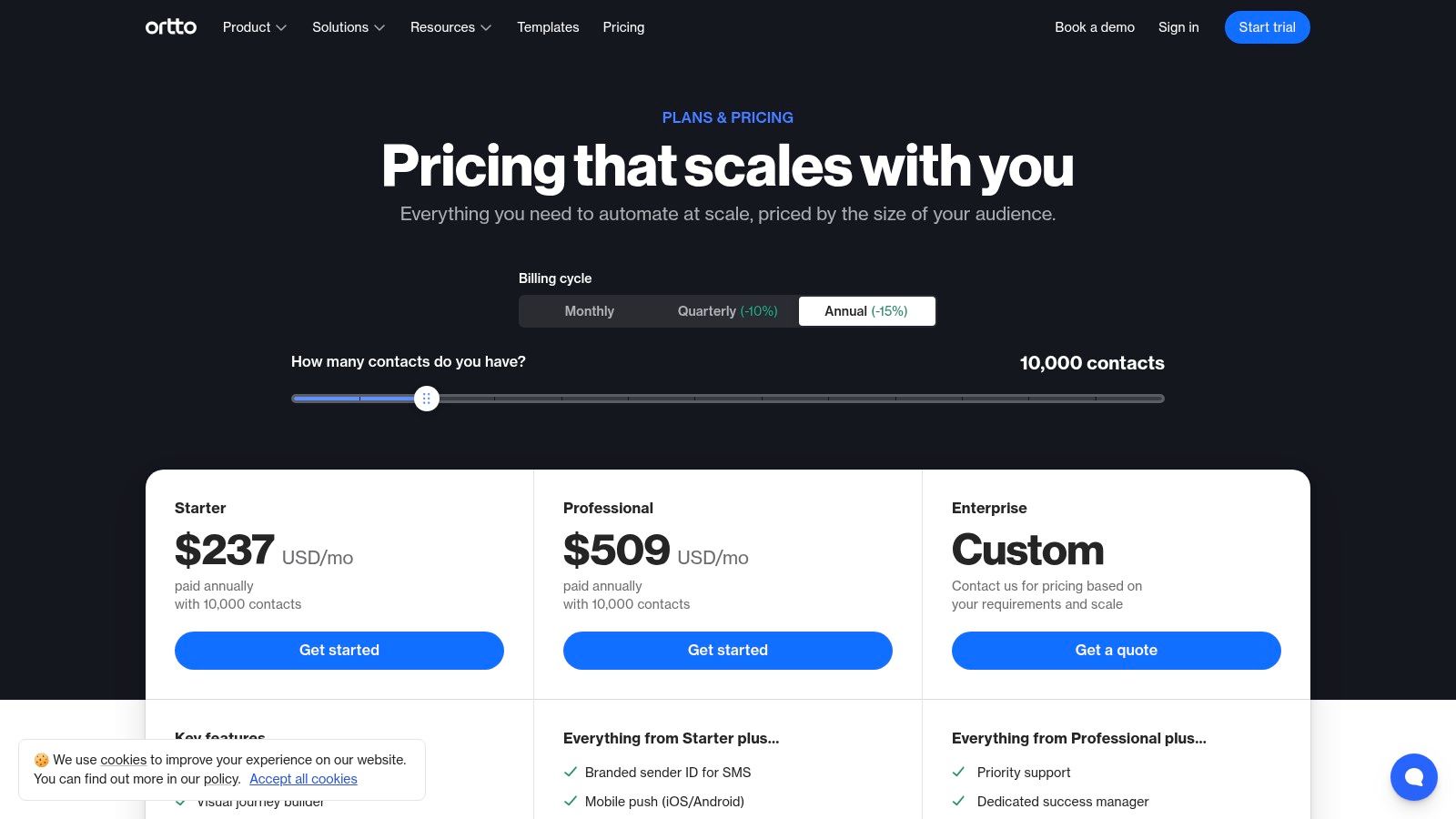
The platform's AI capabilities are geared towards practical application within these journeys. It provides AI-powered suggestions for audience segmentation, helps identify the optimal time to send communications, and offers subject line optimisation to boost engagement. For growth-focused teams, its built-in cohort and funnel analytics provide clear, actionable insights directly within the platform, removing the need to stitch together data from multiple sources. This integrated analytics suite helps teams quickly understand user behaviour and refine their automated campaigns for better performance.
Ortto Key Features & Considerations
Visual Journey Builder: An intuitive, drag-and-drop interface for creating sophisticated multi-channel automation workflows.
Integrated CDP: Unifies customer data to power journey logic, segmentation, and detailed cohort analysis.
Packaged Analytics: Built-in reporting and funnel analysis help marketers measure impact without needing a separate business intelligence tool.
Pricing Jumps: The cost can increase significantly when moving between contact tiers, requiring careful planning for scaling businesses. Some advanced features like SSO are reserved for higher-priced plans.
Feature | Availability & Notes |
|---|---|
Ideal For | Growth teams, SaaS, and e-commerce brands focused on lifecycle marketing. |
Core Strength | A marketer-friendly visual journey builder with integrated analytics. |
Pricing Model | Tiered (Campaign, Session, Business, Enterprise) with contact-based scaling. |
User Experience | Highly praised for its visual and intuitive workflow design. |
Website: https://ortto.com/pricing/
11. Microsoft Dynamics 365 Customer Insights – Journeys
For organisations deeply embedded in the Microsoft ecosystem, Dynamics 365 Customer Insights – Journeys offers a powerful, integrated solution among ai marketing automation tools. Its primary strength lies in its native connection to the wider Dynamics 365 suite (like Sales and Service) and the Power Platform. This tight integration facilitates seamless, real-time journey orchestration based on a unified view of customer interactions across the entire business.
The platform leverages its AI assistant, Copilot, to accelerate campaign creation. Marketers can use natural language prompts to build complex customer segments, generate email and SMS content, and orchestrate event-based journeys across multiple channels. A key differentiator is its focus on enterprise-grade governance, with robust, built-in tooling for consent management and privacy compliance, making it a reliable choice for businesses operating under strict regulatory frameworks. The tenant-level pricing model also offers predictability for larger teams.
Microsoft Dynamics 365 Key Features & Considerations
Copilot Assistance: AI-powered help for segment creation, content generation, and journey building using natural language.
Deep Microsoft Integration: Unlocks its full potential when used with Dynamics 365 Sales, Service, and the Power Platform.
Enterprise Governance: Includes strong, integrated tools for managing customer consent and ensuring privacy compliance.
Heavier for SMBs: The platform is enterprise-leaning and may be more complex than needed for smaller businesses or those not using the Microsoft stack.
Feature | Availability & Notes |
|---|---|
Ideal For | Enterprise B2B or B2C firms heavily invested in the Microsoft ecosystem. |
Core Strength | Real-time journey orchestration powered by unified Microsoft data. |
Pricing Model | Tenant-level licensing with scalable packs for contacts/interactions. |
User Experience | Familiar interface for existing Dynamics users; can be complex for newcomers. |
12. G2 – Marketing Automation Category
While not a tool itself, G2’s Marketing Automation category is an indispensable resource for discovering and vetting potential ai marketing automation tools. It serves as a vast, frequently updated software marketplace where buyers can compare platforms based on live rankings, detailed feature grids, and most importantly, extensive user reviews. This peer validation is its core strength, offering unfiltered insights into real-world performance and user satisfaction.
G2 allows you to filter solutions by company size, industry, and specific features, making it easier to shortlist relevant options from hundreds of listings. The platform aggregates user feedback to award badges for “Market Leaders,” “Easiest To Use,” and “High Performers,” providing quick visual cues to guide your research. It organises a complex market, helping you move from broad exploration to a focused consideration set based on transparent, user-generated data.
G2 Key Features & Considerations
Peer-Driven Validation: Access thousands of independent user reviews to de-risk purchasing decisions and validate vendor claims.
Comprehensive Comparison Grids: Directly compare features, pricing signals, and user satisfaction ratings side-by-side.
Segmented Shortlisting: Filter tools based on business size (SMB, Mid-Market, Enterprise) and specific functionalities to find the right fit.
Potential for Bias: Be aware that vendor placement can be influenced by paid promotion; always verify claims on the vendor's official website. Reviewer context also varies, so weigh feedback relevant to your own company size and use case.
Feature | Availability & Notes |
|---|---|
Ideal For | All businesses conducting due diligence before selecting a new tool. |
Core Strength | Aggregating verified user reviews for transparent software comparison. |
Pricing Model | Free to use for software buyers. |
User Experience | Intuitive and well-organised, with powerful filtering capabilities. |
Top 12 AI Marketing Automation Tools Comparison
Platform | Target audience | Core features | Unique selling point | Pricing & scale |
|---|---|---|---|---|
HubSpot Marketing Hub | SaaS PLG, B2B demand gen, e‑commerce lifecycle teams | Unified CRM + marketing automation, AI content & campaign assist, multi‑channel reporting | All‑in‑one platform with deep native CRM & large app ecosystem; fast time‑to‑value | Contact‑tier pricing; scales startup→enterprise; higher tiers + add‑ons increase cost |
Salesforce Marketing Cloud Account Engagement (Pardot) | Enterprises running ABM, organisations standardised on Salesforce | Lead lifecycle, scoring/grading, AI personalization, native Salesforce Flow | Deepest Salesforce sync and sales/marketing alignment for revenue teams | Edition/quote pricing, annual contracts; best value when already on Salesforce |
Adobe Marketo Engage | Complex B2B/B2C, multi‑brand / multi‑region enterprises | Multi‑touch attribution, AI personalization, strong APIs and integrations | Enterprise orchestration and extensibility for complex journeys | Quote‑based high TCO; implementation often requires specialist support |
Mailchimp (Intuit Mailchimp) | Early‑stage brands, SMBs, small e‑commerce stores | Email, landing pages, forms, journey builder, AI creative assistant | Low barrier to entry, many templates and integrations; free starter tier | Free & low tiers available; limits and overages as lists grow |
Klaviyo | E‑commerce and product‑led brands | Email + SMS, predictive analytics, real‑time behavioral triggers, Shopify/Woo integrations | Commerce‑first lifecycle automation with strong revenue attribution | Transparent pricing by active profiles; costs increase with list size |
ActiveCampaign | SMBs and growth SaaS needing robust automation | Goal‑aware automations, CRM, multi‑channel (SMS/WhatsApp), AI features | Powerful automation at competitive entry price; broad integrations | Modular add‑ons, tiered plans; some features gated to higher tiers |
Braze | Enterprise PLG, mobile‑first businesses | AI decisioning, send‑time optimization, Canvas multi‑channel journeys, BYO‑LLM options | High‑scale, real‑time personalization and sophisticated orchestration | Enterprise quote pricing; significant implementation effort expected |
Customer.io | SaaS PLG and technical marketers | Event‑driven workflows, flexible people+objects data model, multi‑channel messaging | Developer‑friendly, scales with product events and high volume messaging | Transparent tiering; premium features available on higher plans |
Brevo (Sendinblue) | UK SMBs and send‑heavy organisations | Email (send‑based pricing), SMS/WhatsApp, web push, automation, AI assist | Predictable pay‑for‑sends model with generous free tier | Priced by sends (not contacts); advanced features often need higher tiers/add‑ons |
Ortto (Autopilot) | Growth/lifecycle teams wanting CDP + packaged analytics | Visual journey builder, CDP, cohort/funnel analytics, AI suggestions | Marketer‑friendly journey design with built‑in analytics | Contact‑band bundles; pricing steps can be material at scale |
Microsoft Dynamics 365 Customer Insights – Journeys | Organisations standardised on Microsoft stack | Copilot for segmentation/content, real‑time journeys, consent/privacy tooling | Tight integration with Dynamics/Power Platform and predictable tenant pricing | Tenant‑level packs; best value when paired with Microsoft ecosystem |
G2 – Marketing Automation Category | Buyers shortlisting and validating vendors | Live rankings, filterable user reviews, vendor pages, badges | Independent user feedback and category comparison for vendor selection | Free marketplace; placement can be influenced by vendor marketing—verify vendor sites |
Final Thoughts
We've journeyed through the dynamic landscape of AI marketing automation tools, exploring everything from enterprise-grade titans like HubSpot and Adobe Marketo Engage to agile, specialised platforms like Klaviyo and Customer.io. The central theme is clear: the integration of artificial intelligence is no longer a futuristic concept but a present-day necessity for achieving scalable, personalised, and efficient marketing. These platforms are fundamentally reshaping how businesses connect with their audiences, moving beyond simple trigger-based emails to predictive, hyper-relevant customer journeys.
The core takeaway is that the “best” tool is entirely contextual. For a B2B enterprise focused on complex, long sales cycles and deep CRM integration, a solution like Salesforce or Microsoft Dynamics 365 offers unparalleled depth. Conversely, an e-commerce brand prioritising customer lifetime value and repeat purchases will find Klaviyo or Braze’s focus on behavioural data and multi-channel messaging more aligned with its immediate goals. Your choice must be a direct reflection of your business model, technical maturity, and strategic priorities.
Making the Right Choice: A Strategic Checklist
Before you commit to a platform, it’s crucial to move beyond feature lists and assess the strategic fit. Consider this your final checklist to guide your decision-making process when evaluating AI marketing automation tools:
Define Your Primary Use Case: Are you trying to solve lead nurturing, customer retention, ad spend optimisation, or content creation? Pinpoint your most significant pain point and start there. A tool that excels in your core need is more valuable than one that is mediocre at everything.
Audit Your Existing Tech Stack: How will this new tool integrate with your CRM, analytics platform, e-commerce backend, and other critical systems? Seamless integration is non-negotiable for creating a unified customer view and avoiding data silos. Check for native integrations versus reliance on third-party connectors like Zapier.
Assess Implementation and Onboarding: Be realistic about your team's capacity. A powerful tool with a steep learning curve and high implementation cost can become a resource drain if you lack the dedicated personnel to manage it. Look for platforms that offer robust support, clear documentation, and a user-friendly interface that aligns with your team's skill level.
Future-Proof Your Investment: Your business will evolve, and your marketing needs will change. Choose a platform that can scale with you. Does it have a flexible pricing model? Does its product roadmap align with emerging trends in AI and marketing? A short-term solution can create long-term migration headaches.
Putting AI into Action: Your Next Steps
The power of AI marketing automation tools is only realised through deliberate action. Don't fall into the trap of “analysis paralysis.” Instead, take an iterative approach. Begin by identifying one or two key processes you wish to automate, such as abandoned cart recovery for e-commerce or a lead nurturing sequence for B2B.
Use this initial project to build a business case. Measure the impact on key metrics like conversion rates, time saved, or customer engagement. This data-driven proof will not only validate your investment but also build momentum and secure buy-in for expanding your use of automation across the marketing function. Remember, the goal is not just to automate tasks but to augment your team's strategic capabilities, freeing them to focus on creativity, strategy, and building genuine customer relationships. The AI handles the data, so your team can handle the humanity.
Feeling overwhelmed by the options and unsure how to build a tech stack that drives real growth? Ryesing Limited specialises in creating and implementing data-driven marketing strategies for technology companies, using the very tools discussed in this guide. We can help you navigate the selection process and build a scalable marketing engine.
Visit Ryesing Limited to learn how we translate marketing technology into measurable business results.

Frequently Asked Questions (FAQ)
What are AI marketing automation tools?
AI marketing automation tools are software platforms that use artificial intelligence (AI) and machine learning (ML) to manage, automate, and optimise marketing tasks and campaigns. They go beyond traditional automation by using AI to analyse data, predict customer behaviour, personalise content, and make intelligent decisions to improve campaign performance with less manual effort.
How does AI enhance marketing automation?
AI enhances marketing automation in several key ways:
Predictive Analytics: Forecasting customer churn, lifetime value, and purchase intent.
Hyper-Personalisation: Dynamically changing content, offers, and send times for individual users.
Intelligent Segmentation: Creating highly specific audience segments based on complex behavioural patterns.
Content Generation: Assisting with writing email subject lines, ad copy, and landing page text.
Lead Scoring: Prioritising leads more accurately by analysing a wider range of engagement signals.
What is the best AI marketing automation tool for small businesses?
For small businesses, the best tool often balances affordability, ease of use, and scalability. Platforms like Mailchimp and Brevo are excellent starting points due to their generous free tiers and intuitive interfaces. ActiveCampaign is a strong choice for SMBs needing more powerful automation and an integrated CRM without the enterprise-level price tag.
Which AI marketing tool is best for e-commerce?
Klaviyo is widely regarded as the leader for e-commerce brands. Its deep, native integrations with platforms like Shopify and WooCommerce allow it to leverage real-time transactional and behavioural data for highly effective, revenue-driven automation, such as abandoned cart flows and predictive purchase reminders.
Can AI marketing automation tools integrate with my CRM?
Yes, most leading AI marketing automation platforms are designed to integrate seamlessly with major CRM systems like Salesforce, HubSpot, and Microsoft Dynamics 365. This integration is critical for creating a unified customer view, ensuring that both sales and marketing teams are working from the same data to orchestrate a cohesive customer journey.